Measuring Real Engineering Productivity With AI Agents
AI agents inflate code throughput while hiding architectural decay.
Agents have changed what a line of code costs. The traditional instruments engineering teams use to measure productivity were calibrated for a world where every line written represented human reasoning, human judgment, and human time. Those instruments now report the volume of work without measuring whether the work preserved the system they were meant to improve. That is the measurement failure this article is about.
Why the metrics engineering teams already use cannot survive the agent era
A single agent session can touch dozens of files and produce a diff that dwarfs anything a human engineer would ship in a week, and the metric registers this as a win. The instrumentation that teams rely on to judge engineering health was built for a world where humans wrote every line and volume was hard to fake. That world is gone, and the instruments did not go with it. They kept reporting, and teams kept trusting them, but the numbers now measure token throughput, not engineering judgment.
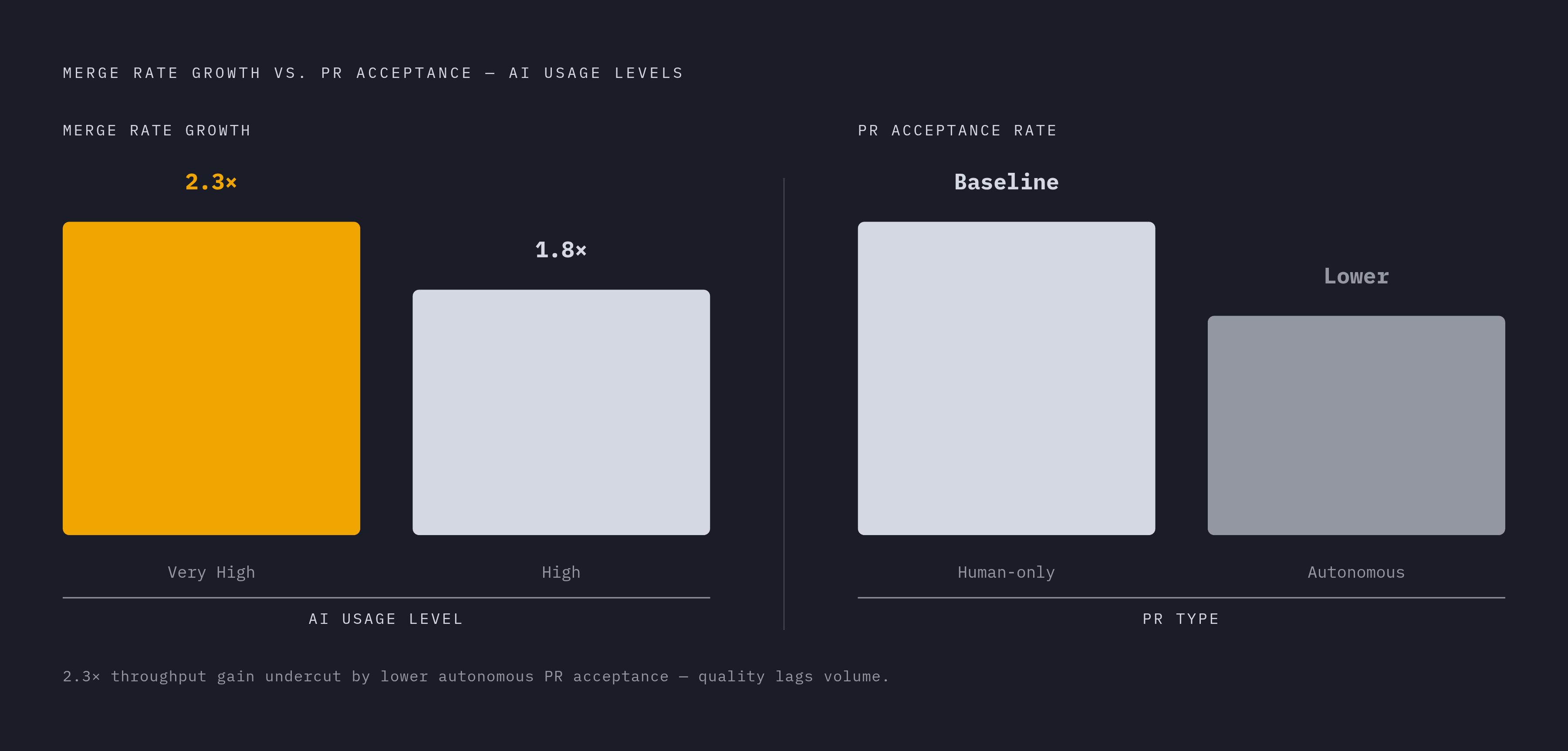
Waydev's 2026 analysis states the core problem plainly: faster code production does not mean faster delivery, and most engineering leaders are currently guessing rather than measuring. The inflation is real and it is measurable. The very highest AI users in LinearB's 2026 AI benchmarks more than doubled their merge rate, reaching 2.3× their June 2025 rate over the course of a year, while the high-usage band reached 1.8×. That number looks like a productivity win until someone asks what was in those pull requests.
The problem is not that agents are unproductive. The problem is that the instruments used to judge productivity cannot distinguish between an agent that wrote sound code and an agent that wrote code quickly. Microsoft's early-2026 rollout study found that adopters of command-line AI coding agents merged roughly 24% more pull requests than they would have otherwise. The study's own authors are explicit that a merged PR is not the same as the value it delivers. The most rigorous study available on agent adoption refuses to equate throughput with productivity. That refusal is the starting point for everything that follows.
What agents actually do during a coding session, and why it strains every downstream system
The unit of work has changed structurally. An agent session now involves reading files, writing code, running commands, and iterating autonomously across many tool calls, a scope no traditional metric was designed to represent. A line count or a PR count captures an artifact of that session, not the session itself, and certainly not the reasoning that shaped it.
Loop engineering research from JAWs@ASE 2026 documents a further abstraction level emerging in mid-2026. Practitioners are no longer prompting agents interactively. They are designing loops, systems that prompt agents on schedules or repository events, bounded by machine-checkable stop conditions. Boris Cherny, creator of Claude Code, described the shift directly in June 2026: "I don't prompt Claude anymore. I have loops that are running. They're the ones that are prompting Claude and figuring out what to do. My job is to write loops."
The loop engineering study, which examined 36,710 software repositories in its exploratory mining work, confirmed autonomous agent loops operating in 217 of 256 matched repositories. But it also found that almost none committed the runtime state files the practice prescribes. The loop's activity remains outside version control entirely. A system is running on a schedule, making decisions about what to build, and the record of what it decided exists nowhere in the repository.
Microsoft's early-2026 rollout study of Claude Code and Copilot CLI across tens of thousands of engineers found adopters merged roughly a quarter more pull requests than they would have otherwise. That is a real lift, but one the study authors explicitly note does not equal value delivered. The consequence of this scope is that a single agent run can alter architecture across files that were never mentioned in the original task. A line-count or PR-count metric cannot see that. It can only see that something was produced.
Why merged PRs and cycle time give a false positive when agents are in the loop
Throughput metrics give a false positive with agent-generated code because agents inflate the numerator while the denominator that actually matters goes unmeasured. The numerator is code shipped. The denominator is whether that code holds the design together. Teams are tracking the first and assuming the second.
LinearB's 2026 benchmarks, drawn from millions of pull requests across hundreds of engineering organizations, show that only a small fraction of PRs at even the most AI-heavy organizations come from autonomous agents. Yet autonomous agent PRs merge at a meaningfully lower rate than human-only ones. That is a signal that throughput and delivery quality are already decoupled. The volume is there. The acceptance is not.
LinearB also notes that AI-touched PRs often move faster at first, then slow as reviewers uncover subtle issues. Cycle time appears to improve while rework accumulates downstream. The diff-size problem makes this worse: agent-assisted changes frequently exceed the threshold at which defect detection drops, straining reviewer working memory precisely when the review is most consequential. A reviewer confronted with an enormous diff is not conducting a review. They are conducting triage.
Some teams will object that cycle time still matters because slow delivery is also bad. That is true. But a cycle time metric that improves because a reviewer waved through an enormous diff is not a productivity signal. It is a risk accumulation signal wearing a productivity costume. The metric says fast. The system says fragile. Only one of those statements is backed by evidence.
How architectural drift accumulates silently while throughput metrics look healthy
The cost that throughput metrics cannot see is architectural drift: the gradual erosion of design intent as agent-generated code introduces patterns, dependencies, and structural choices that were never sanctioned and that no reviewer caught. Drift is not a bug in the conventional sense. It is a slow divergence between what the system was designed to be and what it is becoming.
Drift is structurally invisible to standard tooling. Agents follow style guides, pass linters, and compile cleanly while establishing cross-module dependencies, violating layering rules, or duplicating abstractions the codebase already had elsewhere. The tools catch syntax. They do not catch structure. A forbidden import compiles. A broken layering boundary passes the linter. The architecture degrades and the pipeline stays green.
The runtime state problem compounds this. Because almost no repositories commit the state files that loop engineering prescribes, the architectural decisions an agent made in one session are invisible to the agent in the next. Drift compounds invisibly across sessions. Each loop run starts from the code as it stands, unaware of why it stands that way. Microsoft's rollout study frames the review problem honestly: the tools produce output at a rate that strains the human oversight capacity meant to catch these issues. Throughput grew while the infrastructure to verify design intent did not. The practical outcome is that teams celebrating a rising merge rate may be shipping an architecture that is silently diverging from their own design. The divergence only becomes visible when a new feature breaks something unexpected, by which point the drift is months old and the original reasoning is long gone.
What the SPACE framework gets right and where it still falls short for agent-generated code
SPACE is a meaningful improvement over DORA and lines-of-code counts because it measures multiple dimensions simultaneously and resists gaming. Its strength is that gains in one dimension cannot mask losses in another. A team gaming cycle time will show up in satisfaction or quality signals. That is a genuine advance over single-metric management, and it was designed for human developers, which is both its virtue and its limit.
The framework's dimensions were defined before agents became a primary code author. Performance in SPACE measures outcomes for human work. It has no native slot for the question that now matters most: did the agent's output preserve the intended architecture of the system it modified? The framework can tell a team that something went wrong. It can surface rework, slower cycle time downstream, lower satisfaction. A systematic review of 84 papers on agentic AI evaluation found that only 15% incorporated both technical and human dimensions. The field knows that measurement is imbalanced. SPACE is better than raw throughput, but it still cannot tell a team that the architecture drifted. That requires a structural model of the codebase, not just telemetry on activity and flow.
Why enforcement at the point of merge is more reliable than review-based detection
At agent-generated code volumes, review-based detection of architectural violations is not a scalable strategy. The throughput agents produce structurally exceeds what human reviewers can verify against design intent on each PR. LinearB's 2026 data documents that agentic PRs wait far longer for reviewer pickup than human-authored ones. Reviewers deprioritize agent-generated PRs due to ownership ambiguity and trust deficits, not because agents abandon them upon receiving feedback. The review loop breaks down under volume, and the violations pass through.
Instructions to agents about architectural rules are not enforcement. An agent that cannot verify a constraint at runtime has no mechanism to hold itself to it across a multi-session loop. Loop engineering research identifies machine-checkable stop conditions as a defining characteristic of well-engineered agent loops because subjective or open-ended conditions cause agents to run indefinitely or produce untestable output. The same principle applies to architectural constraints. A rule that lives in a prompt is a suggestion. A rule that lives in CI is a boundary.
Architecture tests integrated into CI are fully deterministic. A rule violation physically prevents the build from passing. A check that exits non-zero and blocks a merge is applied to every PR, automatically, regardless of reviewer load. That achieves a conformance rate that no amount of careful reviewing can match. The corollary is that the right place to measure whether agent work preserved architectural intent is not in the diff but in CI, where the constraint is either satisfied or the merge does not happen.
What a graph-based model of the codebase makes possible that diff review cannot
To measure whether agent work preserved design intent, you need a structural model of what the design actually is. That model is a graph of modules, dependencies, and call relationships that exists in the repo, versions with the code, and can be queried automatically. A diff shows lines changed. It does not show what those changes mean for the system's structure. Whether a new import creates a forbidden dependency, whether a refactored function breaks a layering boundary, whether a new module duplicates an abstraction that already exists elsewhere in the graph, none of that is visible in a diff. It is only visible against a model of what the structure was supposed to be.
A living architecture graph makes these structural facts visible at the moment they change, not after a post-mortem. A developer or a CI gate can ask whether the graph still conforms to the intended design as a machine-checkable question with a binary answer. Loop engineering research shows that well-engineered agent loops are already built around machine-checkable stop conditions and verifier sub-agents. The infrastructure the field is converging on is the infrastructure that a graph-based conformance check fits into directly. The productivity metric that survives the agent era is therefore not PRs merged or lines written but architectural conformance rate: what share of agent-generated merges passed a structural integrity check against the intended design.
How to reframe engineering productivity measurement for a team already shipping with agents
If you use AI agents, genuine engineering productivity is measured against architectural integrity, not throughput. The transition requires replacing or supplementing three specific things: the metric, the instrument, and the gate. Replace the primary metric. Stop treating PRs merged or cycle time as leading indicators of agent productivity. Treat architectural conformance rate as the primary signal and PR throughput as a secondary, context-dependent one.
Instrument the architecture, not just the pipeline. Waydev is right that cycle time and deployment frequency still belong in the picture, but they need a structural counterpart. A graph of the codebase that versions with commits gives a team the instrument to ask whether the architecture the team designed still exists in the code the agents shipped. Make the gate binding. LinearB's 2026 data shows that AI code review produces the widest adoption leverage of any AI tool in the pipeline. Architectural conformance checks in CI extend that leverage to structural integrity. A check that exits non-zero and blocks a merge is the only enforcement mechanism that operates at agent speed.
The developer's role in this model is orchestrator and architectural steward. Loop engineering research documents that the most effective practitioners have already moved from prompting agents to designing the systems and the constraints that govern agent runs. The productivity question is whether those constraints include architectural intent. Teams that measure architectural conformance alongside throughput will find the signals diverge. The ones that converge, fast delivery and a stable architecture graph, represent genuine productivity. Elite teams maintain sub-8-hour PR cycle times, but speed alone was never the point. The ones that diverge represent throughput that is quietly accumulating debt. If the architecture survived the agents' work, the team was productive. If it did not, the metrics lied.