Autonomous Agent Coding Workflows in Production
Agents deliver finished tasks instead of suggestions, requiring new code review practices.
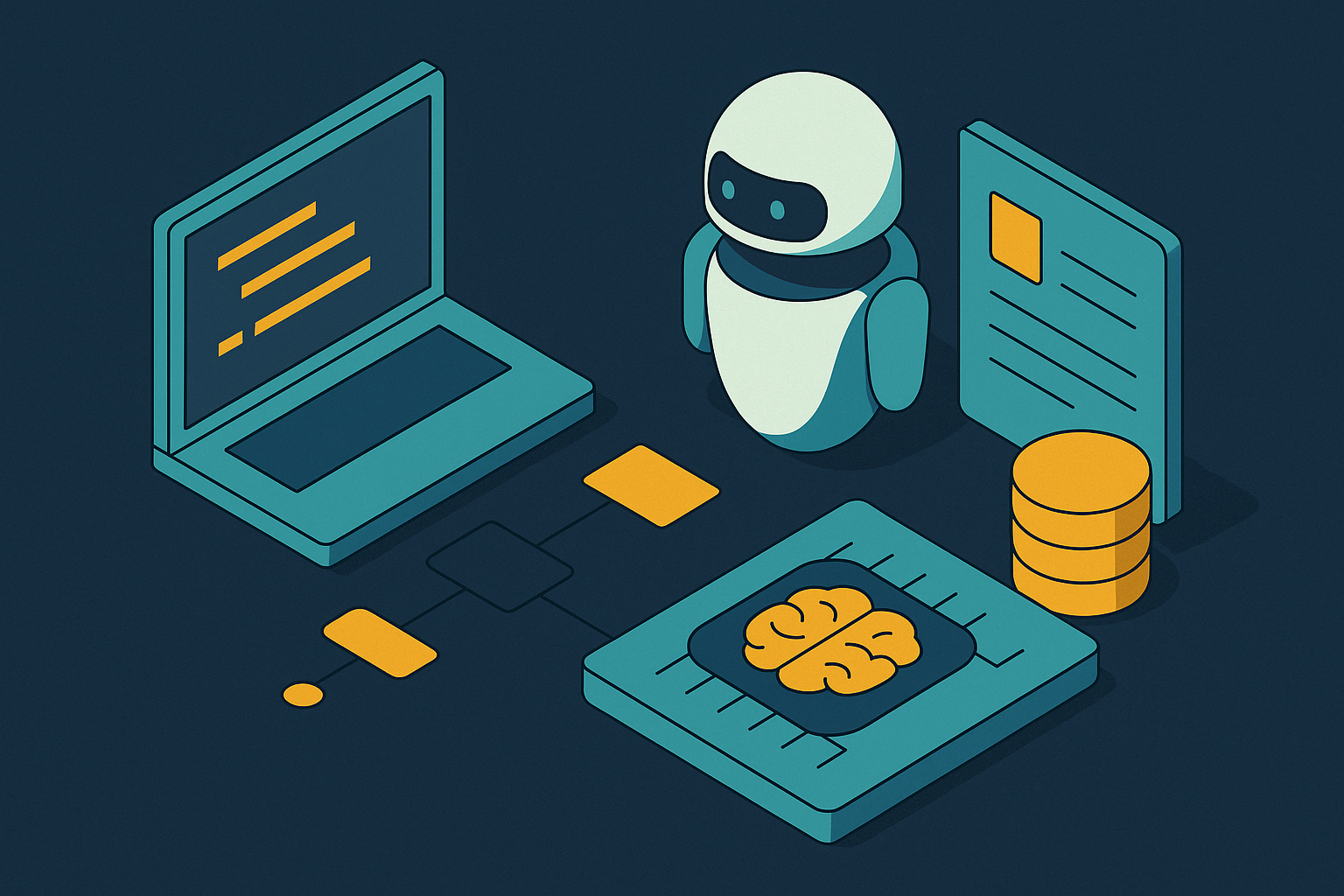
Autonomous agent coding workflows run on a different mechanical model than the AI tools that came before them, and that structural break is the reason old habits around code review and architecture oversight no longer fit. Earlier AI coding tools worked on a simple exchange: a developer typed a prompt, the tool returned a suggestion, and the developer carried every remaining step, including the testing, the integration, and the judgment about whether the output was any good. Autonomous agents work differently. They perceive the current state of a task, reason about what to do next, act through real tools such as file edits, shell commands, API calls, and test runners, observe what happened, and revise their plan, looping through that cycle until the goal is met or something blocks them. An agent can read a failing CI run, trace the cause across several files, write a fix, run the tests locally, and open a pull request, with no developer touching a keyboard at any point in that sequence. The unit of work has changed: what an agent delivers is a finished task, not a suggestion waiting for a human to turn it into one, and that shift inverts the developer's role from doing the work to specifying what the work should be and checking that it was done correctly.
The four-phase loop that agent workflows follow in production
Production agent workflows in 2026 have settled into a hybrid pattern with four stages: plan locally, execute autonomously, verify in CI, and checkpoint at the pull request. Each stage carries its own engineering properties, and each is a place where things can go right or wrong in a different way.
Planning is where work gets broken into file-level tasks, often through an orchestrator or an "architect" mode that reasons about ordering, dependencies, and scope before any file gets touched. More complex systems lean on multi-step planners or tree-of-thought approaches when the task has branching logic that a single linear plan can't capture. Spec-driven development has become common at this stage: developers write detailed feature specifications and architecture notes that the agent references during implementation, and those specs persist as part of the agent's working memory across the task. If you under-specify scope, or don't anchor the agent to a clear architectural model at this point, drift can enter the loop right here.
Execution is where the agent actually edits files, runs test suites, reads the failure output, and self-corrects until the tests pass, all inside a sandbox with tool access to shell commands, git, and whatever APIs the task requires. Memory matters here: agents track what they've already done through a short-term context window, intermediate scratchpads, and longer-term retrieval, and when that tracking breaks down, the agent can loop pointlessly, assume it already fixed something it hasn't, or edit files outside the task's intended scope. Tool calling is what separates an agent from a model that just writes text: a system that can call git blame, run a test suite, and read a stack trace in sequence, acting on what it finds at each step, is operating as an agent.
Verification runs the same linters, tests, and security scans against agent-authored code that would run against anything a human wrote, and the agent's output stays untrusted until the pipeline clears it. Every tool the agent can call, including repo access, CI triggers, and secret managers, should run on constrained credentials with minimal scope, inside sandboxed execution isolated from production data, using task-specific APIs.
The checkpoint is the pull request, and it's the stage where humans stay on the loop rather than in it: reviewing, approving, and merging, instead of supervising every keystroke along the way. Multi-agent orchestration is becoming common at this layer. GitHub's Agent HQ, announced in October 2025 and moved to public preview in February 2026, lets developers run several agents on the same task at once, and each agent reasons about the trade-offs in its own way.
What agents can accomplish at scale when the task structure fits
When a task is well-defined, repetitive, and bounded in scope, agents produce efficiency gains that look nothing like what a team of human engineers could match at the same cost. Nubank needed to split a monolithic ETL repository of more than 6 million lines of code into smaller sub-modules, a project that had initially been estimated to need a large team of engineers working for well over a year. By delegating subtasks across multiple Devin instances running at the same time, Nubank compressed that project into weeks. Fine-tuning Devin on examples of prior manual migrations doubled task completion scores and cut per-subtask time sharply, which shows the agent had to be taught the specifics of the domain before it performed reliably.
Ramp used Devin to automate cleanup of technical debt, including a feature flag removal tool and fixes for hundreds of slow or flaky tests, merging a high volume of pull requests every week and cutting the average time from a flagged bug to a submitted fix down to minutes for time-sensitive Airflow errors.
Those results came from large-scale, highly structured, repetitive problems, not from greenfield development, where you need architectural judgment calls. When Devin was tested independently on general, one-off tasks without specialized setup, it produced a success rate well below what the case studies above suggest, showing the headline efficiency numbers are tied to specific task types. Agents perform best where the engineering hygiene is already decent: a messy repository tends to produce a messy agent. Bug fixes with clear reproduction steps, dependency upgrades, test generation, refactoring backed by strong test coverage, and large-scale repetitive migration all fit the pattern well. But vague product decisions, architecture calls with unclear trade-offs, greenfield development, and security-critical changes without review fit it poorly. The gains documented above hold inside a narrower set of conditions than the headline numbers imply, which raises the question of what happens when teams run agents past those conditions.
How the volume of agent-generated code breaks the assumptions behind code review
Code review was built on the assumption that a manageable number of engineers produce code at a pace reviewers can keep up with. Agents can open dozens of pull requests in an hour, each touching hundreds of files, at any hour of the day, and that volume is the steady state of a production agent workflow, not a temporary spike.
The bugs that show up in agent-generated code differ in kind from the bugs human engineers tend to write. Agent-authored code compiles, follows the style guide, and passes the baseline test suite while still failing under load, on edge cases, or with invalid input, because the problem sits in the underlying logic. A 470-pull-request analysis found that AI-co-authored PRs carried substantially more logic and correctness issues than human-authored ones, and it found security flaws elevated by a substantial margin, error-handling gaps nearly double the baseline rate, and concurrency and dependency correctness issues running at roughly twice the rate found in human PRs.
Agentic drift sits in its own risk category: agents deviate from what the developer actually wanted in ways that current review workflows have no built-in mechanism to catch. Among the documented reasons failed agent-authored PRs fail, unwanted feature implementations and agent misalignment both appear as contributing factors, alongside reviewer abandonment and duplicate PRs as more frequent causes.
A study built on the MSR 2026 Mining Challenge dataset, analyzing 24,014 merged agentic pull requests, examined something that had gone unmeasured until then: how accurately an agent's own PR description reflects the edits it actually made. That gap limits a reviewer's ability to judge reliability, maintainability impact, and clarity at review time, because the description a reviewer reads may not match the diff a reviewer is supposed to be checking it against. One 2026 research response to this problem is a system called "Spotlight," an agent that ranks code regions by review-worthiness instead of spreading reviewer attention evenly across a diff the way existing tools do. That a dedicated system had to be built to solve attention allocation says something about the underlying problem: the diff itself is a poor interface for understanding what an agent built across dozens of files, because no reviewer can hold the full architectural picture of a multi-file change in their head while scrolling through a linear view of added and removed lines.
Architecture drift as the failure mode that accumulates silently across agent runs
Architecture drift is the slow erosion of a system's structural design across many agent runs, each one passing its tests and clearing review on its own, until the system as a whole no longer matches the architecture anyone intended for it. That distinction matters because it means no tool built to catch bugs in individual changes can see the failure.
Agents don't carry architectural judgment the way an experienced engineer does. They optimize for making the current task's tests pass, not for preserving module boundaries, dependency direction, or layering constraints, because those constraints usually exist nowhere in the code itself for the agent to read. The speed at which agents generate code raises the stakes of this gap: a PR that looks clean at review time is still a design decision, and the next agent run will build on top of that decision whether it was the right one or not. Drift compounds across runs in a way that no individual code review catches, because each reviewer is only ever looking at one run at a time.
Spec-driven development partially addresses this because it anchors agents to a written architectural model before they start work. But a spec that only lives in a document, or only in an agent's memory, carries no enforcement power and doesn't version alongside the code it's meant to govern. A written intention is not the same thing as a checked constraint.
The fix has to be structural. The architectural model needs to live in the repository itself, version with the code the way any other source file does, and get enforced in CI. A compliance check that exits non-zero and blocks a merge does more to prevent drift than any amount of after-the-fact architecture review, because it catches the violation before it becomes part of the system. This isn't a new idea in software engineering generally: codifying policy as code is already mainstream in security, through Rego policies, Terraform Sentinel rules, and Kubernetes admission policies, and the same logic applies directly to architectural constraints. Microsoft's Build conference in 2026 announced capabilities spanning the full development lifecycle aimed specifically at verifying that agents behave as intended before reaching production, a sign that the industry is converging on pre-merge enforcement as the layer where this problem actually needs to be solved.
A graph-based representation of the codebase, one that maps every module, file, class, function, and call relationship, makes drift visible in a way a diff never can. When that graph changes in a way that violates a declared constraint, the violation is something CI can catch at merge time rather than something an incident report surfaces months later.
The developer's actual job when agents handle implementation
When machines write code faster than any human could read it, software engineering becomes the discipline of deciding what should exist in a system and proving that it behaves the way it's supposed to. That's a different set of skills than the ones that made a developer effective in 2022, when writing the code was still the bottleneck.
Expert roundtables held in January and June 2026 in Singapore and New York, with roughly 30 to 40 attendees per session drawn from MIT, CMU, NUS, Imperial, Columbia, Harvard, Google, Meta, Amazon, and IBM, among others, converged on two competencies as the ones that now define the job. The first is translating user intent into machine-checkable verification and validation artifacts, the kind of thing that can guide and evaluate an AI-generated implementation. The second is agent orchestration: designing and reasoning about agentic pipelines that coordinate multiple specialized agents working on related parts of a system.
Context engineering, the discipline of giving an agent the architectural model, the constraints, and the scope it needs to execute the task correctly and not just quickly, is the skill that matters when you work with coding agents. So you have to own the architectural model explicitly, as something that exists outside any one person's head, outside a diagram drawn once and never updated, outside a spec document an agent might read but no system actually checks. If you steer agents against a shared, enforced architectural model, instead of writing prompts and hoping the structure survives contact with the next dozen PRs, you ship reliably instead of quietly accumulating drift you won't notice until it costs you. Observability over agent runs follows from the same logic: structured logging of every tool call, every reasoning step, and every decision branch lets a developer trace where an agent went off track and why.
The tools developers work in have to follow the same shift. A code editor built around reading one file at a time was built for a world where humans wrote most of the code by hand. The work ahead is navigating and verifying systems built largely by agents, at a scale and speed no single reviewer can track line by line, which makes orchestration and verification the first-class activities a development environment now has to support.