Agent Task Scoping to Prevent Architectural Overreach
Define agent scope before dispatch to prevent architectural drift.
Architectural overreach is not a symptom of sloppy prompting. Coding agents today operate at repository or feature granularity: they read files across a project, formulate multi-file plans, execute shell commands, run test suites, and deliver committed changes. That is a fundamentally different footprint from line-completion tools, which suggest a function body and wait for a keystroke of approval. An agent that can plan across a repository and act on that plan carries a correspondingly larger capacity to misjudge where its work should stop.
The core of the problem is contextual blindness. When an agent lacks that context, it still has to produce something, so it guesses, and the guess is frequently code that compiles, passes a cursory test, and reads as reasonable in isolation, while contradicting the layering rules or ownership boundaries the rest of the system depends on. The other is silent spec-code drift, where the code keeps evolving under the agent's hand while the specification that was supposed to govern it does not, and the gap between the two stays invisible until it is expensive to close.
You can see this asymmetry in how experienced developers actually describe working with agents. A practitioner study combining field observations of 13 developers with a qualitative survey of 99 more found that agents are well suited to straightforward, repetitive, and scaffolding work when given a well-defined plan, and poorly suited to tasks that require domain knowledge, such as business logic that depends on institutional context no file comment captures. The pattern is that agents are reliable at exactly the tasks where scope is already narrow, and unreliable the moment scope is left for them to infer.
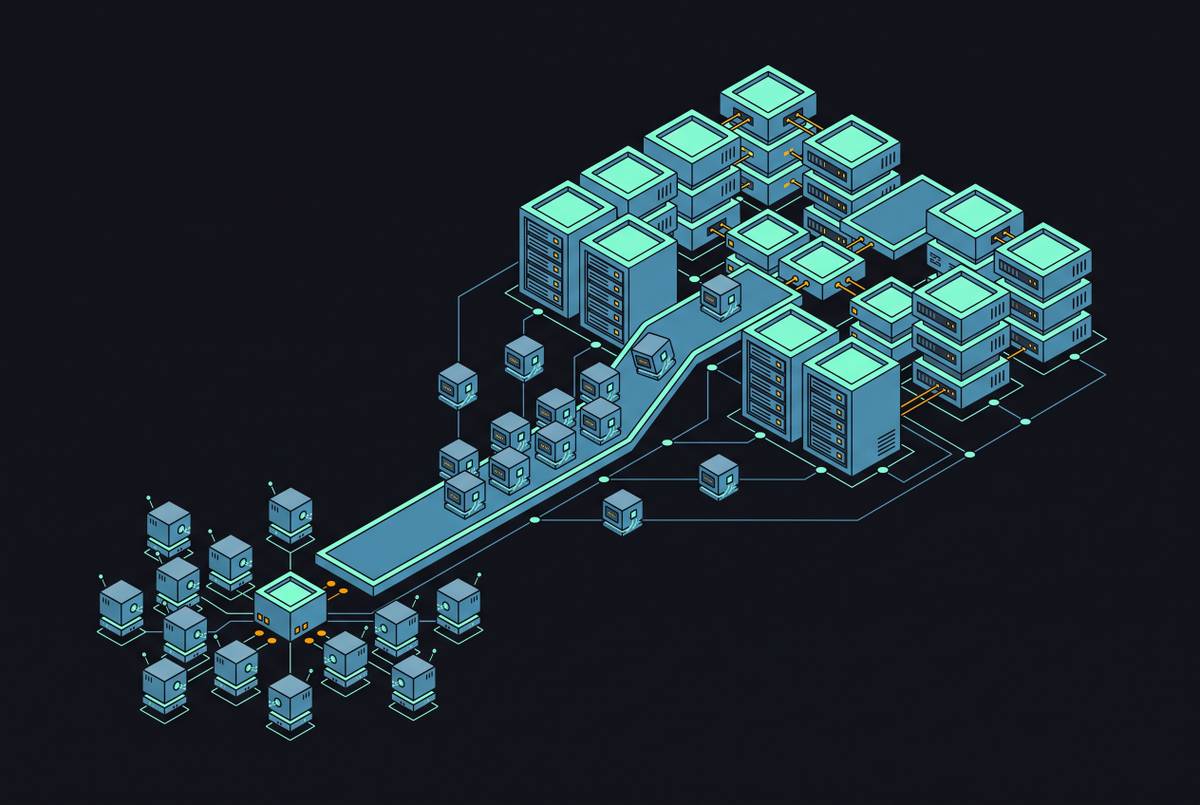
The consequence of that inference failure has already been documented at production scale. A published case study (arXiv:2608.12440) recorded an agent dismantling a core architectural invariant across a large portion of the files in a 717,000-line codebase, with no test oracle in place to catch the violation and no human code review to stop it before it landed. It is a record of what happens when an agent is given repository-level capability and no repository-level constraint.
What unchecked overreach costs a codebase over time
The cost of architectural overreach does not appear in the sprint where the agent ships its change. It accumulates in the structure of the codebase itself, and it concentrates on the engineers least likely to show up in a throughput dashboard. GitClear's Maintainability Gap report, drawn from hundreds of millions of real-world code changes tracked between 2023 and 2026, documents the pattern directly: cross-file reuse declines, copy-paste duplication within individual commits rises, and error-masking constructs become more common. Across these changes, the codebase grows larger, and it becomes harder for any one person to hold in their head.
That growth does not distribute its burden evenly. JetBrains named the inversion precisely in September 2026: code becomes cheaper to generate but more expensive to verify. The scoping framework this article builds toward is an answer to a question that inversion raises directly, which is who pays that verification cost, and at what point in the workflow they pay it.
Defining blast radius before an agent is dispatched
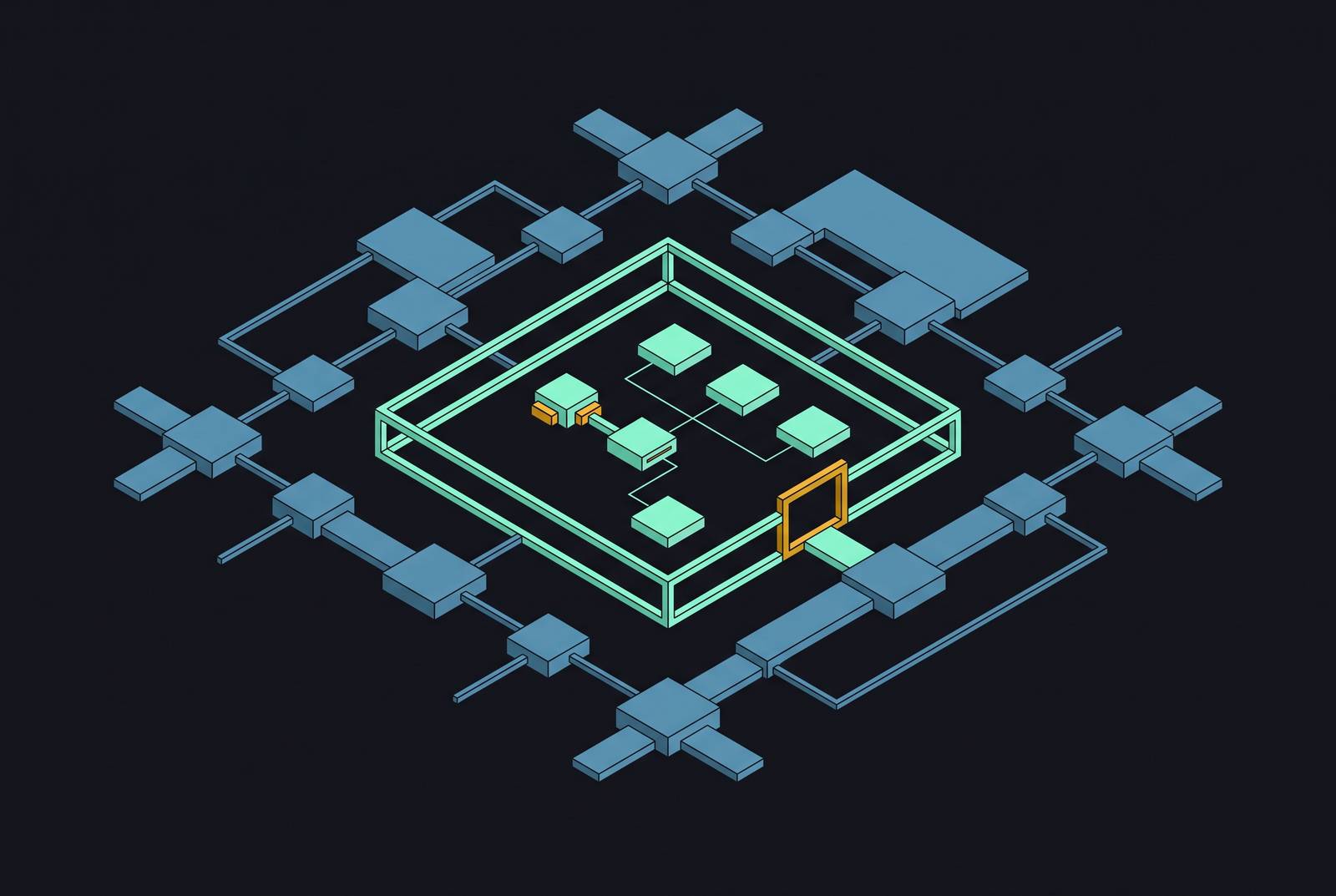
The most effective point at which to constrain an agent is before it generates a single line of code. Blast radius, the set of files, modules, and dependency edges an agent is permitted to touch, has to be specified as an input to the task, not inferred afterward from a diff. A detection control that only notices drift once the agent has already produced a change still forces the team to reprompt, rewrite, and retest, and at the speed agents generate output, prevention costs far less than correction.
Defining blast radius as a concrete artifact means a developer states, before dispatch, which files and directories are in scope, which modules the agent may not touch under any circumstance, which dependency edges may not be introduced or removed, and what the expected diff surface looks like, so that anything exceeding it reads immediately as overreach rather than as an ambiguous surprise to sort out after the fact. The Rakuten case shows what happens when that discipline is absent at real scale. Engineers testing an agent on a complex activation-vector extraction task in vLLM, a codebase spanning 12.5 million lines across multiple languages, found that without explicit boundaries, the agent treated the entire repository as its working surface, because nothing told it otherwise.
Several decomposition heuristics follow from that example and generalize well beyond it. One agent task should produce one logical unit of change, a single feature, a single fix, or a single interface, rather than a refactor bundled with new functionality, because bundling collapses the boundary a reviewer or a fitness function would otherwise use to judge the output. If you cannot bound a task description without appealing to broader architectural intent, you need to split the task before an agent touches it. Logging, error handling, and dependency injection are cross-cutting concerns that reach across the module lines a well-scoped task should respect, so when they show up in a task, its scope has not been bounded.
Encoding architectural constraints as first-class agent inputs
Blast radius tells an agent where it may not go. Architectural constraints tell it what it may not do within the space it has been permitted to work in, and both have to be present when the agent starts generating, not surfaced for the first time during review. The gap that context injection is meant to close is the same contextual blindness described earlier: an agent does not inherit a codebase's layering rules, module ownership, dependency policy, or naming conventions by reading files cold, because none of that intent is encoded in the files themselves.
Practitioners have converged on a standardized mechanism for closing this gap, in the form of named context files, such as CLAUDE.md, AGENTS.md, or.github/copilot-instructions.md, that feed architectural rules directly to a coding agent at the start of a session. These files are not documentation written for a human to skim before onboarding. Instead, the agent reads them as machine-readable constraints when it plans and generates code. A well-built context file states which layers are permitted to call which other layers, which packages fall under which team's ownership, what the dependency policy allows, bans, or routes through review before adoption, which interfaces, contracts, and public API shapes the agent must not break, and which anti-patterns have already caused incidents in that specific codebase and should never recur.
Research on pre-generation context injection points to a measurable downstream effect: codebases that are cleaner and better documented, with context injected before generation begins, reduce the token footprint of what the agent produces, which practitioners treat as a proxy for reduced drift and more targeted output. That benefit depends entirely on the context file staying current. If a team writes a context file once and leaves it untouched as the codebase evolves, the file stops reflecting reality and starts misleading the agent, so a team needs to version these files alongside the code and maintain them the way it maintains the code they constrain. The most durable version of this approach ties the context file to an architecture graph, a structural map of every module, file, class, function, and call relationship in the repository, so that constraints are derived from what the codebase actually contains rather than written by hand from memory and hoped to still be accurate.
Enforcing architectural boundaries in CI so overreach cannot merge
Blast radius definition and context injection reduce the likelihood of overreach. Enforcement in continuous integration is what stops an overreaching change from merging; a constraint that permits a merge to proceed despite violating it functions only as an observation. Architecture fitness functions are automated tests that check a codebase's structural properties and dependency relationships against explicitly defined rules, and they give you the most reliable way to enforce architecture at the speed agents now generate code; they act as a traffic controller between an agent's output and the main branch.
The enforcement toolkit already in practical use spans several ecosystems. ArchUnit verifies layering, package dependency, and naming rules at build time for JVM codebases. ArchUnitTS applies the same discipline to TypeScript, and dependency-cruiser validates a module's dependency graph against defined rules and blocks violations directly in CI. The property that makes all of these valuable is the same: a fitness function that exits non-zero and blocks a merge converts a design intent into an enforceable contract that survives every subsequent agent run, rather than a convention that has to be re-explained and re-checked by hand each time.
None of this comes for free. That is an argument for defining invariants explicitly before adopting agent workflows at scale, not an excuse to defer enforcement until later. Meta's RADAR system illustrates what enforcement looks like once it is built for the volume agents actually produce: as AI agents generate more diffs, with code-improvement activity such as refactoring, dead-code removal, and complexity reduction making up a notable share of that volume, the review pipeline has to scale with it, and automated structural enforcement is how Meta scales that pipeline without a proportional increase in human reviewer hours. The scale involved is not marginal. Published research citing Google's CEO reports that 75% of new code at Google is AI-generated, a proportion at which scoping discipline and automated enforcement stop being best practices and become operational necessities. The next layer beyond fitness functions is spec-driven enforcement, which turns an intended design into machine-readable, enforceable rules and addresses drift at the level of the contract itself. When an agent operates with commit-level autonomy, structural-code-level enforcement and automated test boundaries give you a deterministic check that diff-level review, whether by a human or another model, cannot reliably replicate.
How the three layers interact as a working system
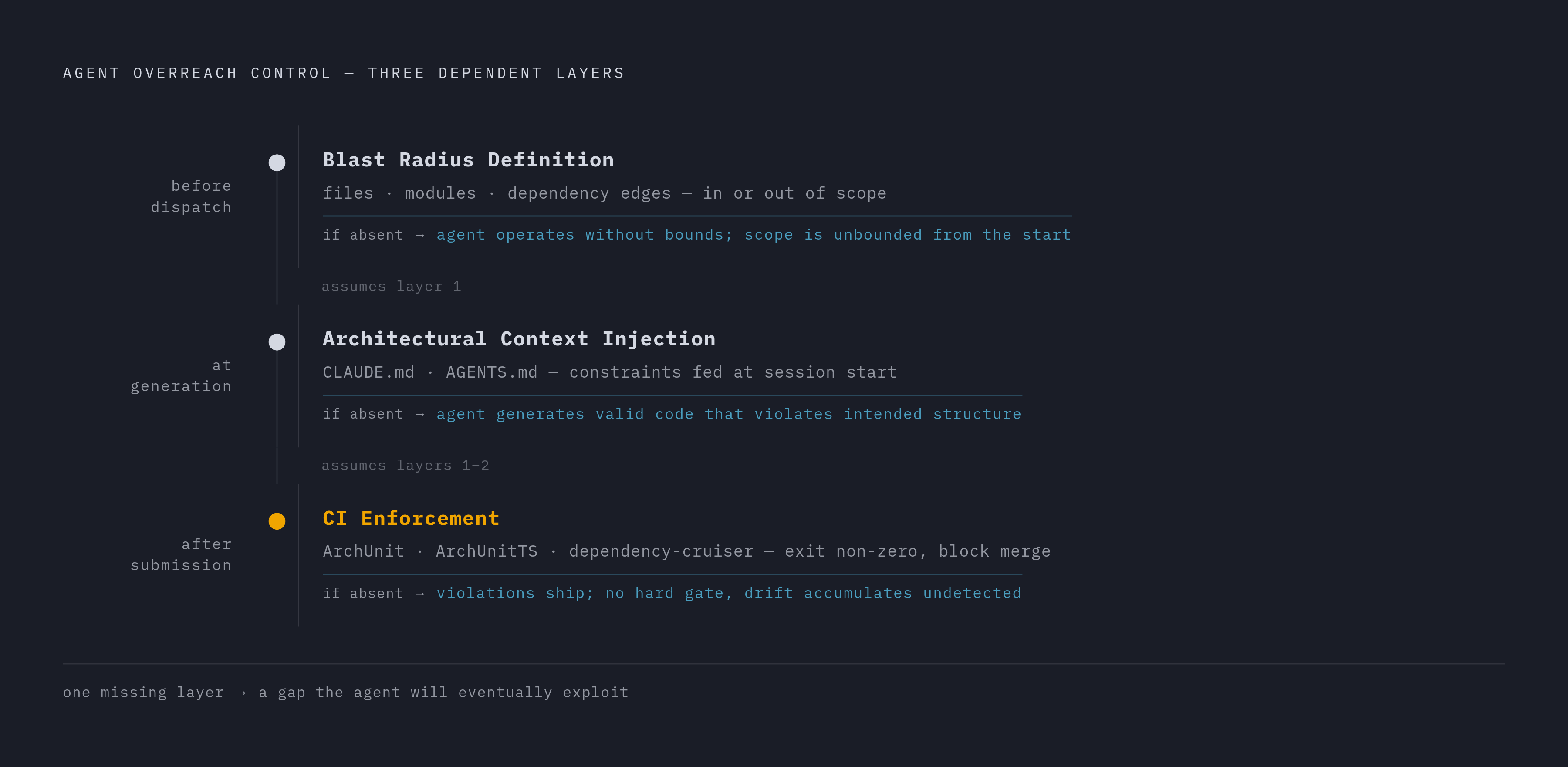
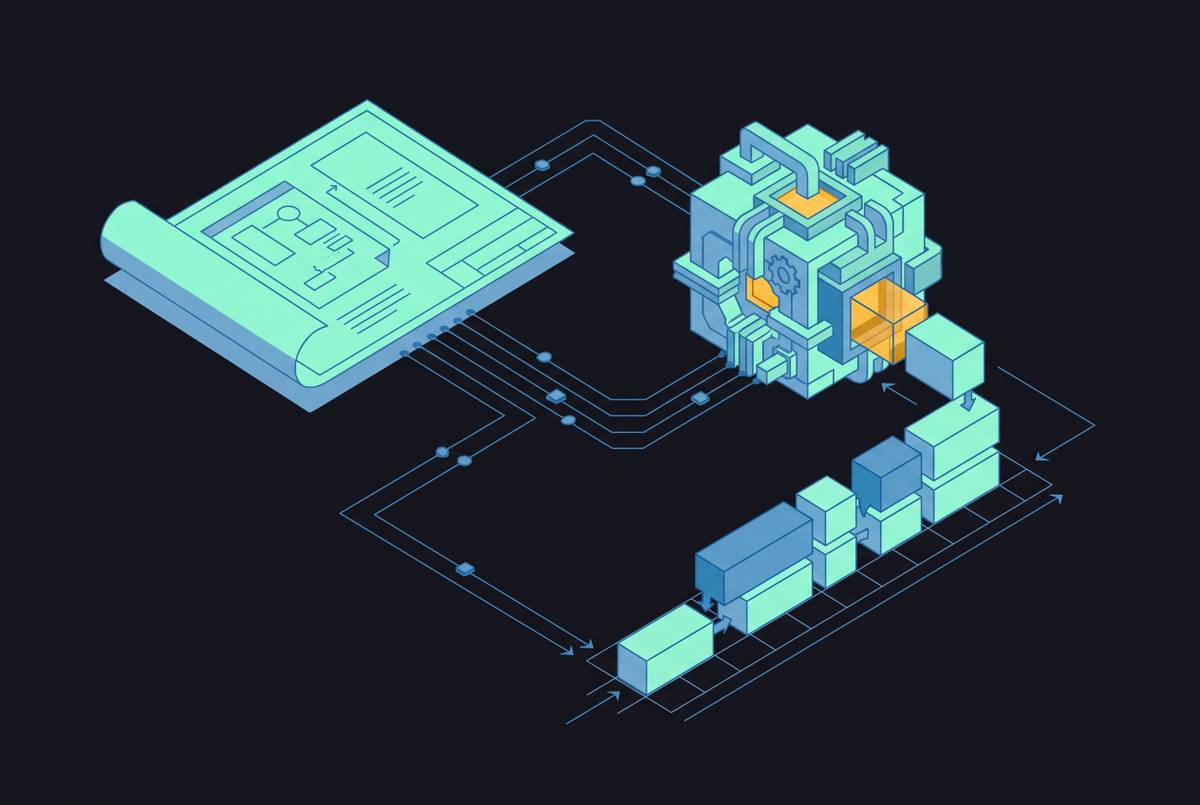
Blast radius definition, architectural context injection, and CI enforcement form a dependency chain, so you cannot just pick among them as three independent options. Each layer assumes the one before it is already in place, and a team that adopts only one or two is left with a gap an agent will eventually find and exploit, whether or not anyone intended it to.
The sequence runs cleanly from before an agent is dispatched through to after its output lands. After the work is submitted, CI runs its fitness functions against the output; if a violation exits non-zero, it blocks the merge, so the developer reviewing the result sees a structural diff, not just a line-by-line diff.
Removing any one layer produces a specific, predictable failure. Omitting a defined blast radius lets the agent's working surface default to the entire repository, and any ambiguity in the task description expands that scope further. Without context injection, the agent can produce code that is structurally valid yet violates conventions it was never told about, and CI only catches the problem late, after a full reprompt cycle is already necessary. Without CI enforcement, constraints exist only as documents and good intentions, and a sufficiently large diff, generated at agent velocity, will eventually contain a violation that a human reviewer simply misses.
Research on the agentic software development lifecycle frames the developer's evolving role in this system as a shift from doing the work to specifying what should be done and verifying what was actually produced. Because of the architecture graph, specification and verification can share a single source of truth. If that graph lives in the repository, versions alongside the code, and drives both the context files agents read and the fitness functions CI runs, then a change to the graph propagates automatically to both layers, instead of requiring someone to update a context file in one place and a fitness function in another and hope the two stay in sync.
What developers own in an agent-first workflow
In an agent-first workflow, the developer no longer produces code directly but designs the system of constraints the agent operates within, a responsibility that demands sharper architectural judgment than writing the code directly would have required. Three specific skills carry the leverage in this arrangement. System-design skill determines how well a task decomposes into a unit an agent can handle independently, without triggering cross-cutting side effects that spill past the intended boundary. Context-design skill determines which architectural invariants need to be surfaced to an agent and how to encode them so there is no room for the agent to reinterpret them. Enforcement-design skill covers whether the fitness functions a team writes catch the invariants that matter, and whether the team maintains those functions as the codebase keeps changing.
A fair objection deserves a direct answer here. The honest reading is that this study and GitClear's dataset are measuring different populations: the 151-repository sample consists of projects whose maintainers chose to disclose AI use, while GitClear's sample spans hundreds of millions of changes across a broad mix of commercial and open-source work. Neither sample cleanly overrules the other. What the comparison does clarify is where this framework applies most urgently, which is to teams shipping at agent velocity without enforcement infrastructure already in place, where the gap between generation speed and verification capacity is widest.
You can no longer keep architectural intent intact just by reading a codebase line by line and reviewing diffs at the pace agents now produce them. The alternative is navigating and steering a codebase from a living map of its architecture, one where blast radius, context, and enforcement are first-class, versioned, and checked automatically, rather than implicit assumptions a team hopes an agent happens to share.
Sources
- Agentic AI in the Software Development Lifecycle: Architecture, Empirical Evidence, and the Reshaping of Software Engineering
- Making Sense of AI Agents Hype: Adoption, Architectures, and Takeaways from Practitioners
- Professional Software Developers Don't Vibe, They Control: AI Agent Use for Coding in 2025
- The Spec Growth Engine: Spec-Anchored, Code-Coupled, Drift-Enforced Architecture for AI-Assisted Software Development
- Rebuild Dossier: Mechanically-Enforced Specs for Agentic App Rebuilds, and What Model-Tier Failures Reveal