Structural Invariants as the Baseline AI Divergence Cannot Cross
Structural invariants turn architectural rules into executable checks that AI agents cannot bypass.
Sponsored by Graphide

Architecture drift in AI-generated codebases happens when changes that are correct on their own break rules about module boundaries, data ownership, or permitted call relationships. Structural invariants prevent that drift by turning architectural decisions into decidable rules that block a merge when violated. Unlike prose guidance or ordinary behavioral tests, they make architectural compliance independent of what an agent remembers.
Why AI agents erase architecture without breaking tests
In the Priya scenario, an agent writes a clean, test-passing endpoint that updates the customer table directly, bypassing the internal customer service API. An architecture decision record in the repository prohibits that access, but the agent never encounters it. The endpoint bypasses the service’s audit hooks. Cleanup consumes a sprint despite the apparently successful implementation. The failure lies in organizational memory.
Human developers internalize a codebase’s conventions over time. Agents start sessions without that understanding unless the decisions about the codebase’s conventions are in their context. That leaves them able to write many files that look sound on their own but together break rules about ownership and dependencies. Passing tests leave those violations intact. Hartwig Grabowski’s 2026 Spec Growth Engine identifies a related failure as “silent spec-code drift,” in which implementation changes without a corresponding specification update or a signal that the two have diverged.
Why linters, tests, and prose guidance cannot close this gap
Linters check what their rules tell them to check, while behavioral tests compare the results they get with test oracles. Neither turns an architectural decision into a constraint on its own. A test can confirm that an endpoint updates a customer record without checking whether the authorized service performed the write. Recorded decisions need a connection to executable checks.
Prose guidance supplies context but imposes no barrier. A CLAUDE.md file, README architecture section, or ADR directory depends on the agent consulting and applying its contents. Even AI review has explicit limits. Cloudflare’s public account of its review system describes up to seven specialized agents, with review tiered by risk, but acknowledges that static review cannot verify downstream API compatibility or catch subtle race conditions. Structural checks address declared relationship constraints upstream of review, although they do not replace verification of runtime behavior or downstream compatibility.
What a structural invariant actually is, and what it is not
A structural invariant is a decidable rule about module boundaries, data ownership, or call relationships that must hold for the codebase to remain architecturally valid. The build can confirm or falsify it. “Controllers must not import from the persistence layer directly” is such a rule when the layers and prohibited imports are defined. “Prefer dependency injection” is a convention because applying it still requires interpretation. The distinction is not how strongly the document expresses a preference, but whether a check can reject a violation.
Three properties establish that distinction, namely decidability, structural scope, and independence from the agent’s context. Decidability means the check produces a binary result. Structural scope means the rule governs relationships between modules. Context independence means the constraint holds regardless of the task, available context, or apparent reasonableness of the change. A locally elegant implementation receives no exemption.
The Spec Growth Engine separates contracts from design within each specification node. Public interfaces and their obligations belong to the contract, while internal implementation belongs to design. This keeps enforcement focused on architectural commitments. Srinivas Rao Marri’s 2026 Constitutional Spec-Driven Development expresses non-negotiable constraints through a versioned, machine-readable Constitution. Its authority is architectural rather than a claim that every encoded rule is a legal obligation.
The three categories of structural invariants worth encoding
Module boundary rules say which layers may depend on which others. A prohibition on controllers importing persistence code protects layered separation even when the resulting endpoint would behave correctly. Scope globs can pick out the files covered by the rule, and import checks can tell whether a forbidden dependency is there. The boundary must be explicit enough to test. The Spec Growth Engine represents boundaries through ownership paths and declared dependencies, which also limit the context supplied to an agent working within a node.
Data ownership rules identify the authoritative writer for an entity. The customer service’s exclusive authority over customer writes is the rule missing from enforcement in the Priya scenario. An ownership declaration must name that service and ban writes through other paths, going beyond a description of the preferred API. This category protects the decision about who may change state.
Call-path rules govern permitted routes through internal APIs and external integrations. A rule can require all access to an external service to pass through a designated intermediary. Its enforcement shape is a dependency or call-graph assertion protecting the permitted route.
How to encode invariants so they are machine-readable and agent-proof
To make these categories enforceable, define each rule’s scope, express its constraint in a parseable form, and version it with the governed code. The ADR frontmatter approach uses scope globs to identify affected paths and a Decision section expressed with standardized requirement keywords such as MUST NOT. An ordered ADR index gives the agent a way into the decisions. The keywords make the obligation explicit, but they do not execute it. The relevant architecture check must still translate that obligation into a test of imports, ownership, or calls.
For ownership rules, name both the owning module and the write paths that are banned. For call-path rules, record the permitted dependency relationships against which the actual graph will be compared. In the Spec Growth Engine, each node’s contract layer holds its public interfaces, obligations, and declared dependencies, while its design layer holds choices about how to implement them. It versions the specification graph and code in the same commit, making a contract change visible as a change to an artifact.
Other approaches support the same separation between constraints and their proposer. The Constitution maps constraints to code locations and preserves their security or regulatory rationale. Nidus’s 2026 published results describe how projects under its rules import guide-books and check proof obligations against the current obligation set on every commit. Three LLM families delivered a 100,000-line system under those obligations. The constraint surface is the durable component.
Making enforcement deterministic through hooks, architecture tests, and the drift gate
A deterministic check exits non-zero, states the violated rule, and prevents the governed merge. Architecture tests can check layer dependencies this way, while a drift gate compares the structure of the code with the declared contracts. The Spec Growth Engine blocks a merge when the code diverges from those contracts. A reviewer’s confidence cannot substitute for that result because confidence does not establish that the specified relationship holds.
The ADR Stop hook illustrates a narrower deterministic gate. When the agent believes it has finished, the hook reads ADR scope globs, compares them with changed files, and scans the session transcript for evidence that the relevant records were opened. If a governed file changed without its ADR being read, the hook exits non-zero and explains why the agent cannot stop. This proves consultation. Requirement keywords clarify what the agent must honor, but a separate structural check is needed to establish that the resulting code does so.
Cloudflare’s 2026 figures report 16,000 merges blocked by its AI code reviewer under its Engineering Codex, demonstrating probabilistic review operating as a merge gate. The distinction remains essential for contract constraints. An enforcement verdict must resolve to an explicit rule, observable evidence in the code, and a reproducible result.
The human role that enforcement cannot replace in setting and updating invariants
Deterministic enforcement cannot decide whether an architectural constraint is correct. A stale rule can block a legitimate change just as reliably as a useful rule blocks drift. The Spec Growth Engine assigns boundaries, public contracts, and root invariants to the Human Architect role, including consequential changes and exceptions. Those decisions require architectural judgment. Enforcement preserves the decision after it is made.
The cost is real and remains ongoing. Teams must identify the rules, encode their scope, connect them to checks, and maintain them as the architecture changes. An invariant should therefore be owned, versioned, and deliberately revised rather than quietly bypassed when it becomes inconvenient. Faster generation increases the importance of that discipline because more implementation can accumulate behind an unexamined decision. Explicit constraints cost less than recovering from the drift they prevent.
How do you detect architectural divergence beyond the diff?
A merge gate finds violations, but developers also need to understand changes to the structure before CI rejects them. A large textual diff is a poor representation of module ownership and call relationships. In the Priya scenario, a 340-line pull request has clean code and passing tests that hide the broken rule. More line-by-line attention does not itself supply the missing architectural criterion. Detection requires comparing the implementation’s relationships with the boundaries and dependencies the specification permits.
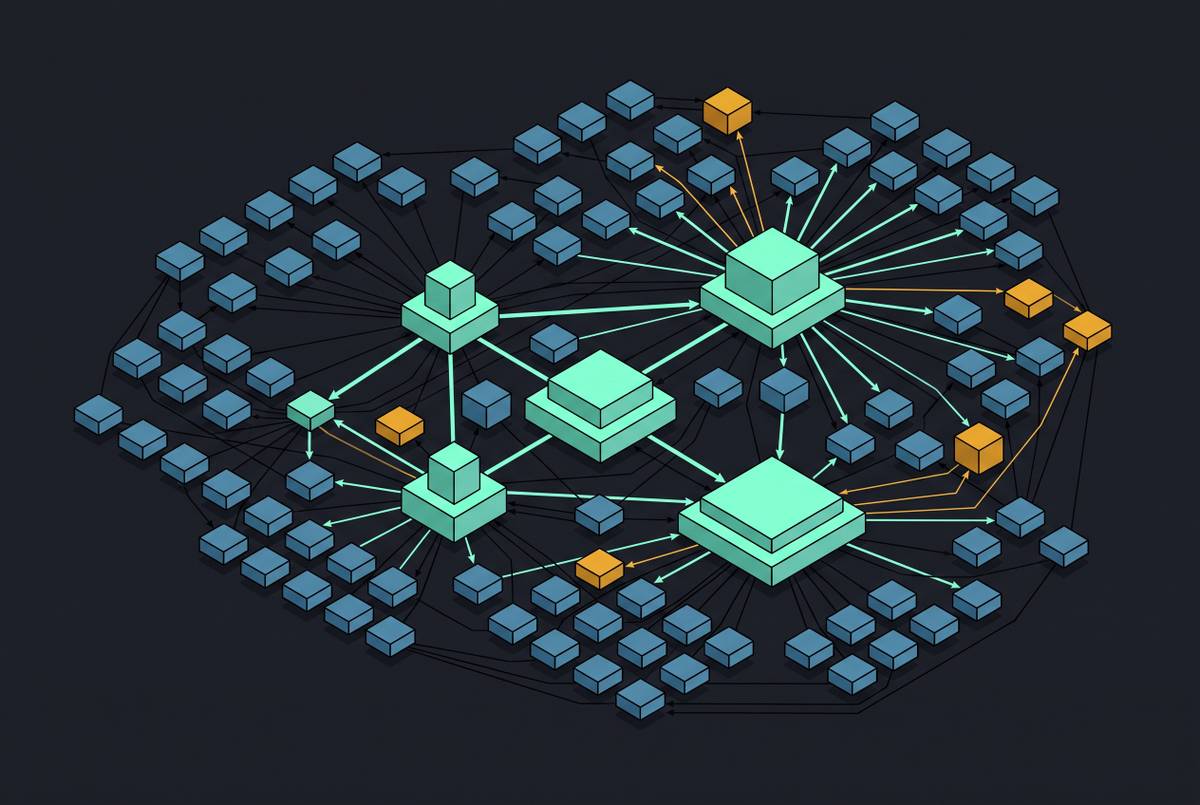
A live, interactive architecture graph provides that view. It shows module relationships, call paths, and ownership boundaries as the agent builds, making structural change visible. The Spec Growth Engine’s Spine context assembler applies the same principle from the agent’s side. It supplies the ownership path from root to target module together with declared dependency contracts, rather than treating the whole repository as unrestricted context. The graph defines the relevant scope.
A developer can inspect whether a change crosses an ownership boundary or introduces an undeclared dependency before the merge check runs. The gate then tests the encoded constraint reproducibly. These are different responsibilities, namely understanding the proposed structure and deciding whether it satisfies the rules. Neither requires treating a readable diff as evidence of architectural compliance.
Starting with the highest-impact invariants in a practical order
Root constraints whose violation cannot be repaired locally provide a practical starting point. The Spec Growth Engine specifies root constraints covering persistence, security, external integrations, and error taxonomy before feature work begins. Within that foundation, begin with data ownership. Naming the authoritative writer for each entity addresses the class of failure that bypasses audit hooks or changes state outside the responsible service.
Next, encode layer dependency rules as architecture tests in CI. They establish which layers may import from which others and give the build a direct way to reject forbidden relationships. Then encode call-path rules for external integrations, including the gateway through which access is permitted. This protects dependency decisions from being silently introduced or removed. The sequence moves from authority over state to permitted internal dependencies and then to controlled integration paths.
The investment accumulates across features. Nidus describes a constraint surface in which each obligation excludes a class of unacceptable output, while deliberate versioning preserves the ability to change the architecture. The Constitution’s 2026 case study found a 73% reduction in security defects compared with unconstrained AI generation, supporting proactive constraints in that domain without establishing an equivalent structural-drift reduction.
Sources
- Constitutional Spec-Driven Development: Enforcing Security by Construction in AI-Assisted Code Generation
- The Spec Growth EngineSpec-Anchored, Code-Coupled, Drift-Enforced Architecturefor AI-Assisted Software Development
- Nidus: Externalized Reasoning for AI-Assisted Engineering
- The Spec Growth Engine: Spec-Anchored, Code-Coupled, Drift-Enforced Architecture for AI-Assisted Software Development